

[convertkit form=1899477]
Preparing Skoolie Floor
After cutting out all those seats, on our school bus, I worked to get down to the bare metal floor where I found that I would need a rust converter!
Before I began the build part of our bus conversion process, however, I need to treat the rust.
Treating surface rust is a critical part of bus conversion. If you’re going to turn an old school bus into a new home, you won’t to make sure it lasts!
How Rust Converters Work
Rust converters use acids to convert rust (iron oxide) “into inert, insoluble products” such as iron phosphate, iron tannate, or other form depending on the acid used.
A Variety of Options
Several products claim to be the best, which can be overwhelming. I set out to choose the best value product: one that will:
- Convert the rust
- Protect against future rust
- Not cost more than the bus
- Be user-friendly (environmentally safe, people and dog safe, easy to apply and quick to dry).
Our travels will be limited to southern areas in the winter, thus I don’t need the product to be bulletproof. I do, however, want it to last. Thus, I ended up choosing FDC Rust Converter Ultra as the best value. It purports to accomplish all of our established goals at $47.00 a gallon.
A study done in 2013 compared the performance of several products. Rustoleum outperformed Corroseal, Aspho and RCx427. In the process of researching, I discovered FDC Rust Converter Ultra that was not part of the study.
Converter Comparison
| FDC Rust Converter Ultra (Our Choice) | Corroseal | Ospho | Rustoleum Rust Reformer |
| Less than $50 | Under $50 | Under $40 | Under $100 |
| Tannic Acid | Sodium Carbonate | Phosphoric Acid | Tannic Acid |
| 500 square feet | 500 square feet | 400 Square Feet | 400 Square Feet |
| Water | Water | Water | Water |
| Dry time: 20 minutes | Dry time: 30 minutes | Dry time: 24 Hours | Dry time: 15 Minutes |
| I like the price and the fact that it also functions as a primer for the final paint coat. It also received a 4.5 / 5 star review on Amazon. | “Corroseal is a water base rust converter combined with a non-pigmented high quality latex metal primer” | (a “rust-inhibitive coating”) | Notes: This would have been my choice based excellent performance in studies and reviews. Ultimately, I decided that the cost was too high. |
| Check Price | Check Price | Check Price | Check Price |
Preparing the Surface
- Clearly, I needed to remove the seats, the rubber matting, and the plywood floor. You can see my video on The Best Way to Remove School Bus Seats or the blog article.
- There was no easy way to pull up the rubber mat. I wrestled it, I used a pry bar. I swore at it. I won.
- I ripped up the plywood using a 12″ crowbar, a 36″ crowbar, a hammer, and sheer will. I found it difficult to drive the end of the 36″ crowbar under the plywood, so I used the smaller crowbar to create a gap. Using the rounded edge of the crowbar, I popped the edge up. Then I switched to the long end of the bar and continued prying. Once I got about half-way, leverage decreased. On the more stubborn pieces, I grabbed an old blade and my skill saw, and just cut the pried up portion of the plywood. This gave me access to a new “edge” which was much easier to pry up.
- Cut and grind remaining screws and bolts from the metal floor. I used and angle grinder with a cutting wheel at first to cut out all the remaining screws and bolts. Then I switched over to a grinding wheel to get the deeper rust. Finally, a put a wire wheel on the angle grinder to get down to bare metal.
- Seep and vacuum,
- Hose out and mop with Simply Green and rinse. The product calls for a clean and oil-free surface, so Simply Green functioned as a dual purpose soap and degreaser. I parked the bus with the back door facing downhill so water would drain that way.
- Dry with a fan.
Applying Rust Converter
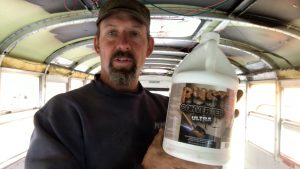
- Roll it on! The roller didn’t get the seam between the floor and the wall. Rolling also struggled to get the rust converter on rough textured areas, so I used a brush there..
- Dry.
- Apply 2nd Coat
- Admire Work. (Hey, this Bus Conversion work is stressful…gotta take time to celebrate the victories!)
Results
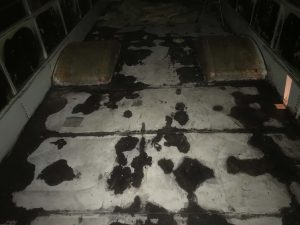
Where I applied thin coats, it did, indeed, dry in 20 minutes. (It was a sunny day, about 55 degrees.) In spots like the seams between the floor and walls, I slopped it on pretty thick and it took over an hour to dry.
The rust areas turned purple rather quickly, then slowly turned to black. In thicker spots, however, it didn’t penetrate, so I had to go back and grind deeper.
Next Steps
Although the website claims that it prevents “future rust,” when I contacted customer support they said that “paint is always recommended” and that “a high-quality oil based paint [or latex] extend the life quality and duration of the [rust] conversion.”
I chose a rustoleum oil based paint. While it tool longer to dry, a felt more confident in it’s ability to prevent as much rust as possible.
Conclusion
I am pleased with the results of FDC Rust Converter Ultra. It seemed to convert the rust to a stronger metal, was easy to use, easy to clean up, and was significantly less expensive than competitors. It did have an odor, though I didn’t find it unpleasant.
Feel free to post comments, ask questions, shout encouragement, or write a haiku!
Up next, patching rust holes!
If you like this blog post, you’ll love our free PDF that shows you how you can save HOURS or even DAYS over the course of your build. Click here for immediate access!