

Choosing the “Right” lifejacket is like choosing the “Best” river to paddle. It depends. But matching your paddling with the right equipment can be a life-saving decision.
Lifejacket vs PFD
When I guide rafts and begin the day with the safety speech (or the “Interactive Safety Presentation” as I like to call it), I talk about life jackets. Except I make the joke that our insurance company longer allows us to call them that anymore because they are not guaranteed to keep you alive, just afloat. We are now to call them “Personal Flotation Devices.”Â
PFD sounds so…boring. I think I’d prefer calling a life jacket a Mae West like they did in the 40’s.Â
No matter what we call them, they do save lives. According to the American Boating Association, in 2016, 80% of known boating deaths were from drowning and 83% of those victims were not wearing a life jacket. Â
That’s a somber statistic.
So wear them! Get cool tan lines that declare, “I’m a boater!” Provide yourself with an extra place to hang your sunglasses and a comfy pillow for napping on the rocks after lunch. Stay alive!
Lifejacket LawsÂ
The life jacket rules and regulations vary from state to state. Â
According to the Boat US Foundation, “There must be a properly fitting life jacket for each and every person aboard a recreational vessel.” In addition, “life jackets must be USCG approved, in serviceable condition and the appropriate size for the intended user.”
In addition, children are required to actually wear them when the boat is underway unless they are “below decks or in an enclosed cabin.” The age requirements vary from state to state but can be checked here.

Lifejacket Types
Specific lifejackets serve different purposes. The chart outlines the differences.
| Type | Flotation (in pounds) | Use |
| 1 | 22 | Often used offshore. The design of this lifejacket meets the needs of people operating in rough water. The design helps keep the face of an unconscious person out of the water. The size of it may be uncomfortable to wear. More for commercial use, they are not readily available to the general public. |
| 2 | 15.5 | Remember those big orange life jackets that wrapped around your neck and lay on your chest like an apron? These feel bulky but are designed to position an unconscious swimmer face up. |
| 3 | 15.5 | Probably the most common lifejacket. Slimmer and more comfortable, this jacket, with it’s lower flotation will float a person in calm water and would unlikely keep the face of an unconscious swimmer out of the water. Often times neoprene life jackets are used by water skiers. |
| 4 | 15.5-22 | These function as “throwable” flotation devices. Rings, for example, the icon of the lifeguard, offer 22 pounds of flotation. Seat cushions, often associated with canoeing, have 15.5 pounds of flotation. |
| 5 | 15.5-22 | “Special Purpose” lifejackets. For example, a whitewater raft guides (like me!) often wear rescue vests which have a ring attached to a releasable strap. The person can then attach and release ropes to this ring in rescue situations. |
The Best Lifejacket for Adults
As you can see from the above chart, for most recreational uses, a Type 3 PFD would adequately protect a boater from drowning. Most canoeing environments don’t present heavy waves. And, in most situations, you will be paddling with other people should a boat gunwale whack you in the head and knock you out. These paddle buddies will hopefully stage a rescue. Â
The comfort and ease of wear, however, will increase the likelihood that you will wear it. And, quite frankly, the best lifejacket is the one you wear!
As a guide and certified Swiftwater Rescue Technician, I wear a Type V rescue vest. Since I try to save money, I wear the same vest kayaking and canoeing. Â
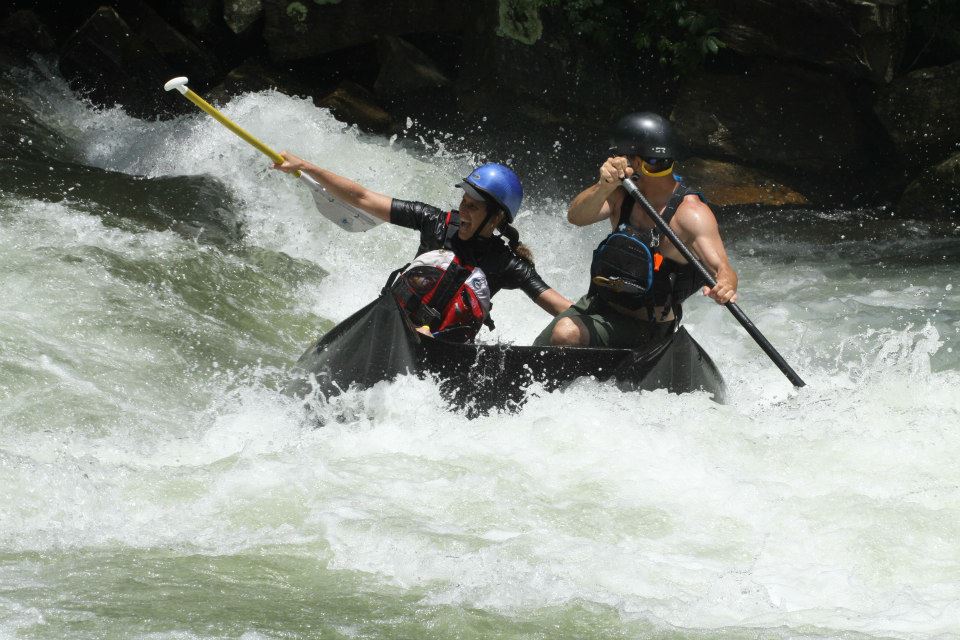
For comfort while kayaking, my vest has only 15.5 pounds of flotation. I have found after flipping a raft and swimming Class V whitewater, that 15.5 pounds don’t really keep me on top of turbulent whitewater! Â
Since these swims rarely happen, I opt for the comfort of less flotation and find that my lifejacket keeps me adequately afloat!
Lifejackets for Kids / Youth

Again, the best lifejacket is the one they wear. Or, in other words, the one they complain less about wearing! First, model safe behavior by wearing yours. Second, make it “cool gear” by outfitting it with a signal whistle, and, if they are old enough to handle it responsibly, a river knife. Knives can be useful tools for spreading peanut butter and whittling marshmallow sticks…far more likely scenarios than cutting entangled rope.
My kids all wore Type III jackets both in motorboats and in canoes. When my daughter began kayaking whitewater as a teenager, I bought her a Type V whitewater vest with a knife and a whistle. Â
Lifejackets for Baby
First, and most importantly, make sure that you are making the right decision for you and your family! I am a big fan of getting kids out in the water. However, make sure that the scenario is manageable! Consider the weather, the severity of the water conditions, and your support system (are you by yourself or do you have multiple paddling partners around to help in case something goes awry?
Then be sure to choose a lifejacket appropriate for babies. I would choose a Type II that will more likely turn baby’s face up. I also want a crotch strap to make sure that it stays in place.
Lifejackets for Dogs
The DFD, or doggie flotation device can provide security of mind for dog owners. My lovely bride insists on our dogs wearing them although I always feel pretty confident in the dog’s swimming abilities in our situations. (I once watched our golden retriever attempt to “retrieve” a mooring buoy”¦for an hour. We finally had to drag him to shore. He wasn’t wearing his DFD and didn’t seem to need it.)

On the other hand, we just brought our 6-month old puppy on a canoe trip. In Maine. In April. The water was cold and there was some ice on the shore. For some of the shorter rapids, we let her follow along by running down the river bank. At one point, she fell in. She managed to swim to shore and I think that the DFD helped speed her shore recovery.
I do like the handles on top of DFD’s…they can be “handy” to muckle ahold of an overboard pooch and get them back into the boat.
Be sure to size them appropriately:Â firm but comfortable.
Lifejacket Sizes
It is critical to properly size lifejackets! Â
A lifejacket that is too small will not float you properly. More importantly, you’ll look for any excuse to not wear it. Make it as comfortable as possible so that you enjoy paddling…the whole point of paddling!
On the other hand, it can’t be too loose either. A loose life jacket is still a lifejacket that wants to float. If you find yourself overboard, you will sink, the jacket will float, and you’ll find it sliding up around your mouth and nose. Now, not only will you struggle to breathe through the water but you’ll also be picking nylon fibers out of your teeth.  Not fun!
Lifejacket companies offer charts matching weight to lifejacket size. Use the chart to determine your size; however, once your new PFD arrives, don’t be afraid to return it for a correct size if it doesn’t fit!Â
Conclusion
Wear your PFD! Make your friends and kids and your friends’ kids wear their PFD’s! You’ll look cool and be safe!