

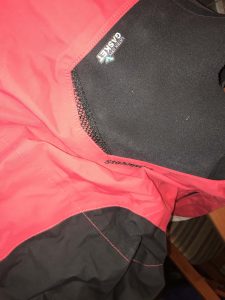
Storing drysuits correctly can make or break your first paddle of the season.
Imagine one of the first warm, sunny days in April. You’re sick of winter, stoked for spring, so despite icy waters, you grab your gear for an early-season paddle with your buddies.
You show up at the put-in, toss a car mat on the ground to stand on while you change, then proceed to rip right through a neck gasket rendering it…useless. Guess you’ll be the shuttlebunny. Bummer.
Let’s avoid that scenario! Use these Pro-Tips to properly maintain your gear. Not only is that stuff expensive, but you don’t want to miss out on paddle time either!
Washing Your Drysuit or Drytop
I always feel nervous about washing water-proof gear. It feels like I might wash the magic water-repelling stuff right out of it. But, it’s okay”¦
Washing before storing drysuits helps eliminate contaminants like sunscreen, insect repellent, body oils and PBR foam that can compromise the high-performance fabric. That’s good!
NRS and Kokotat disagree on the process, however. NRS claims that you should never use a washing machine because it “may damage the waterproof membrane or coating and is NOT recommended.“
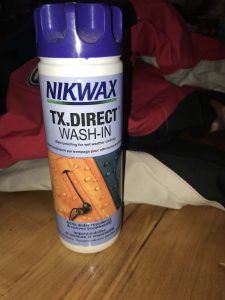
Kokotat, however, suggests “using cold water, delicate cycle, gentle liquid soap, with no bleach or harsh chemicals, and high water volume, in a front loading machine.”
It can be a challenge to determine how “gentle” my Arm and Hammer laundry determine is (doesn’t sound too gentle, does it?) so I opt to use Nikwax which is designed for drygear in mind. Â
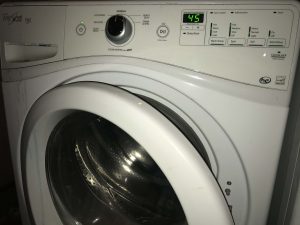
I’m also fortunate enough to have a front-loader washer, so I can do this at home. If you don’t have one, head out to the laundrymat or come on over and we’ll sip a beverage and swap “No-S**t-there-I-was” stories about the Machias River while the washer spins round and round.Â
Rinse well…Kokotat recommends giving it an extra rinse in the shower or running it through a second rinse cycle. Then line dry. DO NOT RUN GEAR WITH GASKETS THROUGH A DRYER!!
DWR Treatment
DWR, or “Durable Water Repellent” is a chemical treatment on the outside of the drytop or drysuit fabric that prevents water from soaking in. Instead, it beads up and gets flung off as you crest over the tops of waves, do cool paddle tricks and wave to your poor friend on shore who blew out a gasket so is shuttlebunnying.
This treatment isn’t what actually makes the fabric waterproof. Fabrics themselves have this quality. For example, Gortex is a membrane that has teeny-tiny little holes that are big enough for vapor molecules to pass through, but small enough so that water molecules can’t get in. Pretty cool.
The DWR, however, can wear off over time and then water coats the fabric, limiting it’s ability to breathe and makes you feel cold, clammy and overall icky. Thus spraying the fabric with something like Revivex will help maintain the garment’s ability to bead water.
Zipper Treatment
Once again, NRS and Kokotat disagree. Geez, you’d think they were in competition or something!
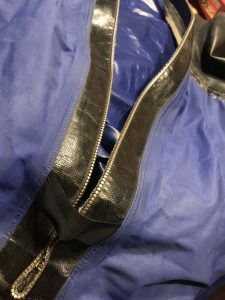
NRS wants you to use gear aid zipper lubricant, then keep metal zippers open. (Plastic ones closed). They feel that closing the zipper will compress the sealing components of the zipper and make them less waterproof over time. (Imagine your Pelican box without the gasket).
Kokotat also recommends a zipper lubricant: McNett Zip Tech Semi-Solid Zipper Lubricant (Whew..that’s a mouthful!). But suggest leaving metal zippers two inches open and plastic zippers completely closed.
Gasket Treatment Before Storing Drysuits
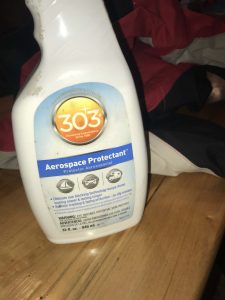
Using 303 Aerospace Protectant on your gaskets will prolong their life. The UV blocking chemical compounds will reduce the damaging effects of the sun on the latex and keep them more supple and less likely to tear.
I spray some on a cloth, then use the cloth to wipe the gaskets.
Storing Drysuits
I prefer to avoid hanging my drygear on a hanger. Hangers seem to stress neck gaskets and shoulder areas. Thus, I loosely fold it and put it in an airtight bag.
Both NRS and Kokotat agree that ozone adversely affects gaskets on drygear. Thus, after your gear has completely dried, store it in an airtight container.
Conclusion
Boating gear is awesome. As we always say, there’s no such thing as bad weather, just bad clothes. But it ain’t cheap! So, as the true dirtbag paddlers we are, we don’t have gobs of dough to be shelling out for new gear all the time. Storing drysuits properly allows us to be warm and dry. And have money to buy new boats!