

Knowing how to patch a tire should be part of any boater’s skill set! We often find ourselves on dirt roads miles away from cell phone signals and tire repair services.
Last summer, I had ventured up to the river to paddle with my daughter. After a brief jaunt down the Golden Road, we pulled into camp just before dark, cooked dinner and went to bed. When we got up the next morning our left rear tire was so flat it rested on the rim.
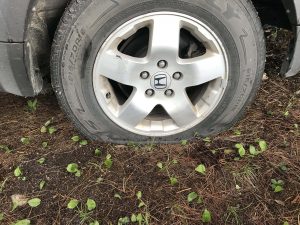
We were at least a 45-minute drive to the nearest gas station and could have been an epoch before AAA could have arrived.
Did we despair? Throw our hands in the air then plunge ourselves into the river?
Nope.
We pulled out the portable compressor and tire patch kit.
Many paddling settings involve remote dirt roads littered with sharp rocks that love to eviscerate tires. Many times you find yourself an epic journey away from help. In order to salvage a precious day of paddling your best hope, in the words of Ralph Waldo Emerson, is to be self reliant!
Equipment Needed
Patching a tire is actually relatively simple and can be done in under a half an hour, depending on the strength of your compressor and the size of the tire.
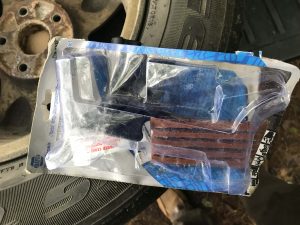
You will need a plug kit that can be purchased at an auto parts store or Walmart. You will also need a portable air compressor that plugs into a vehicle power port. (They used to be called cigarette lighters”¦.) For the record, I really like the ones with an auto shut-off feature. That way you’re not constantly leaning over checking the pressure!
Remove the Tire
It’s possible to patch the tire with it on the vehicle provided that you can find and access the leak, but it’s much easier to remove the tire. This step is pretty basic, but for you tire novices out there: using a lug wrench, loosen each of the lug nuts one turn before jacking up the car. Once the tire is off the ground it will want to spin when loosening the nuts so keeping it on the ground for this first step will save some aggravation.
Also, if your arms are tired from paddling, use your weight! Stand on that lug wrench to loosen those dust-filled lug nuts!
Jack up the Car
Place the jack under the car as dictated by the user’s manual. Be sure to use level ground and, to be extra sure, place rocks or logs in front and in back off the other tires to prevent rolling. Once the tire is off the ground, finish removing the lug nuts (keep them in a safe place to avoid using the Holy Mother of all Swear Words). Remove the tire.
Locating the Leak
Hook up the portable compressor and fill the tire with air. Like you were taught in CPR, look, listen and feel for air. Once you have found the leak, splash a bit of water on it to help mark its location.
Reaming the Leak
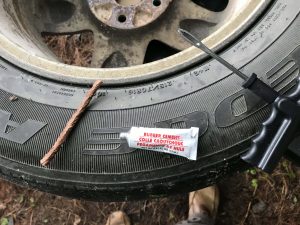
Using the reaming tool from the tire patch kit, ream out a hole. This will help remove any foreign matter in the hole and make it more uniform. I usually leave the reamer in the hole while I complete the next step to keep as much air in the tire as possible. It speeds up the reinflation process!
Inserting the Plug
Remove one of the stick patches from the patch kit, squirt some rubber cement on it, then insert it into the hole like you are threading a needle. Pull it through so that half of the plug sticks out from either side. Insert the tip of the plug tool so that a bit more than half of the plug is inside the tire. Then slowly pull the tool out. The plug should remain in the tire. Snip off the excess plug.
Reinflate the Tire
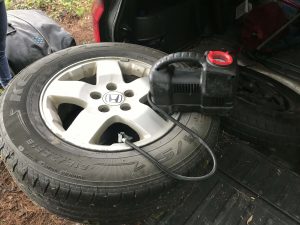
Using the compressor, reinflate the tire to the correct PSI. You can find this number on the inside of the driver’s side door where it latches.
Reinstall the Tire
Reinstall the tire. Be sure to tighten the lug nuts in an alternating pattern (tighten one, skip one, tighten one, until they are all tight) to properly seat the tire. I usually step on the lug nut wrench for a quarter turn to make sure they are tight.
Go Boating
Rather than have your day ruined by waiting for a tow, patch the tire yourself and enjoy a day on the water!