

Wow. It’s been a year in our skoolie conversion process.
In some ways it feels like we’ve accomplished quite a bit.
Then I look at what still needs to be done and I don’t feel anywhere close to finished!
So here’s a look at what (and why) we’ve done in the last year.
The Skoolie Conversion Backstory
I guess you could say that it all started with Jimmy Buffett in the late 90’s. A bunch of friends would caravan down to what was then “Great Woods” near Cape Cod to see Buffett concerts. The next year we decided to rent a 15 passenger van so we could all ride together. THEN we discovered that renting an RV wasn’t much more expensive.
That was the way to travel! While our non-drinking friend drove (we bought his ticket) the rest of us made blender margaritas, cooked nachos, and played cards in the back.
Freakin’ awesome!
And, ironically, while I LOVE traveling and seeing different places I HATE the act sitting in a car seat for hours on end.
Julie and I also love traveling around paddling various rivers around the country and South America. In my next career iteration, I aspire to work as a migrant wave farmer, guiding in the North in the summer, the South in the fall, honing my skills in Ecuador in the winter, and guiding in the West in the spring.
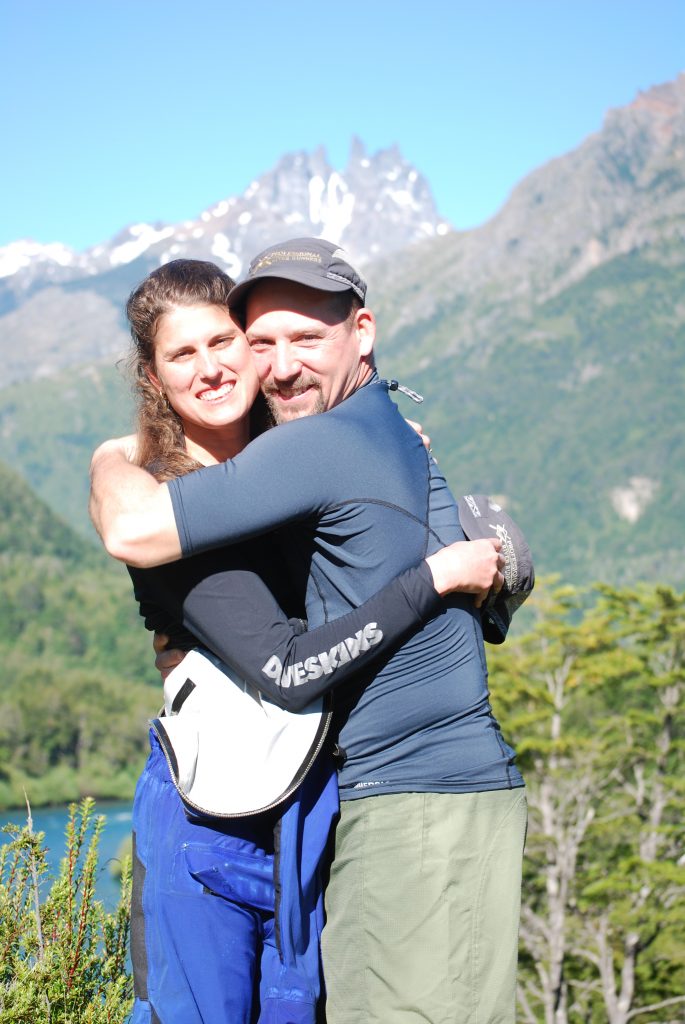
So owning a house on wheels would really help facilitate that lifestyle.
I’ve still got a few more years as a teacher before I can put that life plan into play, so we had planned to begin the bus conversion project a few more years down the road.
And started the dangerous process of looking.
Skoolie Conversion: Buying a Bus
The Search
So one night last fall I found a 2003 Bluebird with a DT 466E, Allison 2000 transmission, and 160,000 miles for under $2500. I had seen multiple social media and forum posts praising this engine and transmission combination.
So I’m on the couch on my laptop. Julie’s upstairs.
Me: “Jules?”
Julie: “Yeeeesss”¦.?” (Clearly I had used the “what-if” tone of voice.)
Me: “What if we find the RIGHT bus for the RIGHT price now?
Pause.
Julie: “I guess we buy it.”
Thus began another chapter in our life.
Skoolie Insurance and Temporary Registration
We jumped through the rigamarole of getting insurance and a transit tag from the town office. Insurance can definitely be tricky but we found working with State Farm pretty easy.
(For $25 we got a temporary registration that allowed us to legally drive the bus from Plattsburgh, NY to Maine.)
I called my buddy that lives near Burlington, Vermont and told him we were looking at a bus and would love to stop in and see him on the way back home.
We set off early on a Saturday morning on a quintessential New England Fall day. Bright sun, brilliant foliage and a possible skoolie conversion project in our future.
We zigged through the western foothills of Maine, zagged through the mountains of New Hampshire, zipped along the Winooski River of Vermont, then chugged across Lake Champlain on the ferry.
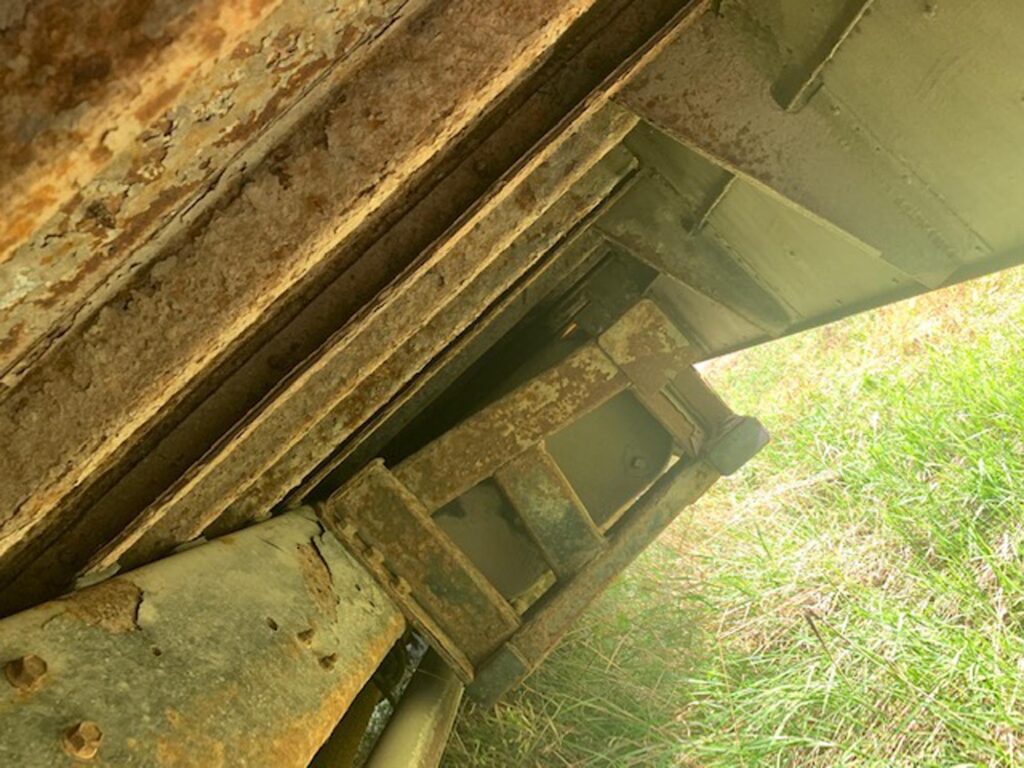
We finally arrived in the small town in Eastern Upstate New York and looked at the bus. It, indeed, had the engine and transmission that we wanted. It had a bit more rust than I had hoped, but a reasonable price.
How Far to Travel When Buying a Bus for a Skoolie Conversion?
While many people advocate traveling to non-rust belt states to buy a bus for a skoolie conversion, I had my doubts. I mean, what’s easier, finding a bus halfway across the country, flying (or driving?!) there hoping to broker a deal, then driving it all the way back? Or remediating some rust? On a bus that I hope will rarely, if ever, see a snowy road again? Â
We opted for rust.
Skoolie Purchase!
So we exchanged cash for the title, then hit the road. Since the bus had sat for a bit, the one battery (it really should have two) struggled to crank the bus to life.
We decided to keep the bus running on the ferry rather than risk trapping a bunch of other vehicles on a boat behind a bus!
This turned out to be a wise decision because when we pulled into my friend’s driveway in Vermont and turned the bus off, it wouldn’t start again.
So we had to make a quick run to the store to get another battery which fired up the bus again.
The Demolition Phase of the Skoolie Conversion
We left Vermont late Sunday morning and arrived back home mid afternoon. Excited to get started (of course!) we began with the our skoolie conversion with seat removal. While different strategies work for different people, given the rusty bolts we decided the grinder approach worked best.
Seat, Heater and Floor Removal
I used a grinding wheel to cut a wide notch at the base of each bolt head. Then I switched to a cut-off wheel to remove the bolt heads. (Without pre-grinding notches I found that the thin cutoff wheel would either dig into the rubber floor or flex and break). We used an impact driver to remove the rusted nuts and bolts along the chair rail.
I attacked the rubber / plywood floor next. With no easy way to remove the rubber, I just ground off the screw heads and used brute strength and ignorance (and a 3 foot prybar). This strategy worked for the plywood, too. I found that using a skill saw to cut the plywood into smaller sections allowed me to maintain leverage. I found larger pieces more awkward to handle.
After removing the floor we patched a few rust holes, used a rust converter, then painted the floor.
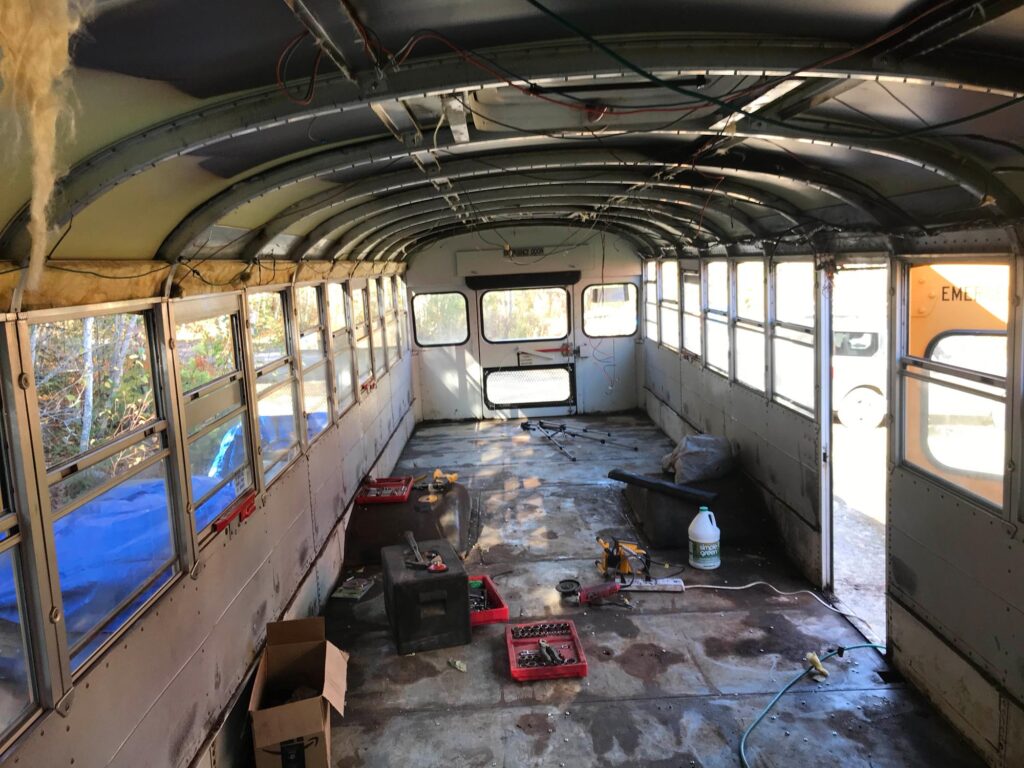
And just in the nick of time, too. Weather was starting to get cooler and I worried that paint wouldn’t dry! And we didn’t have an adequate heat source for bare metal in a 35′ vehicle!
Moving into the fall and winter, cold and snow slowed progress. Paint and glue wouldn’t dry, so we ventured into other projects.
A Free Camper to Repurpose for our Skoolie Conversion!
I found a free camper on Craig’s List. A gentleman told me he had hoped to turn it into an ice shack but his wife was making him get it out of the yard. I got it home, pulled out all the working appliances and tanks and then Julie told me that I needed to get it out of the yard.
This step saved us quite a bit of money in our skoolie conversion!
Skoolie Conversion Floorplan
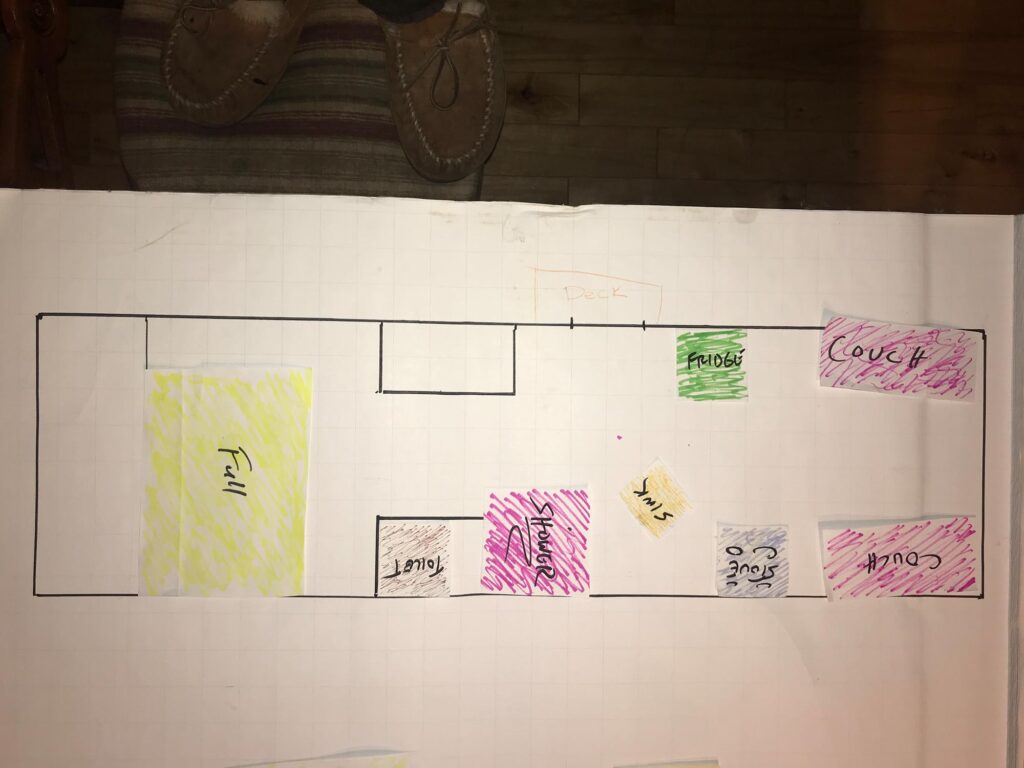
We worked on our floor plan, both with chart paper and cardboard models. It turned into a fun drinking game with friends, actually. “Here…take this footprint and paper cut-outs of bus “features” and fit them in there!”
Wires, Flashers, and Stop Sign Removal
I removed a large box of wire, the stop signs, the flashers. (And the bus still started!)
I rewired some of the switches and custom built a switch console.
When I wanted to accomplish something but didn’t know what to do I sanded the exterior in expectation of paint…someday. I used a blowtorch to remove the decals and reflective tape. (And Goo-Gone. Many people have had success with an eraser wheel, but I didn’t. Later I learned about a trick using a multi-tool which I used to take of some weather stripping around the door. Yes!! I wish I had known that trick before!)
The Skoolie Conversion Construction Phase
In March two things happened.
First, the weather warmed. A bit.
Second, Covid hit and we started going to school remotely. Which meant, as an early riser, I could get most of my school work done in the wee hours of dawn and work on the bus for through a good chunk of the day.
Skoolie Conversion Framing
I started the skoolie conversion construction with the floor insulation and subfloor.
We moved on to removing, cleaning and painting windows.
Other windows we replaced with sheet metal.
We covered over the flasher lights and destination signs with riveted sheet metal. (Repurposed from the bus ceiling!)
I framed walls.
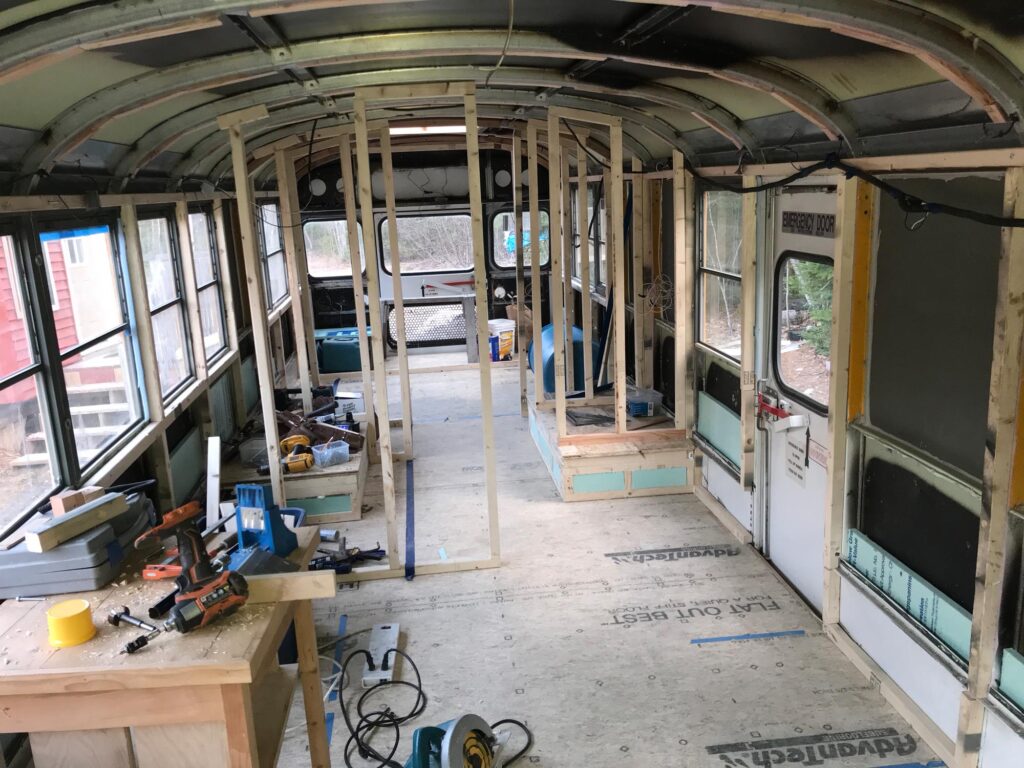
We moved into April and I was putting in 8 hour days.
Skoolie Electricity
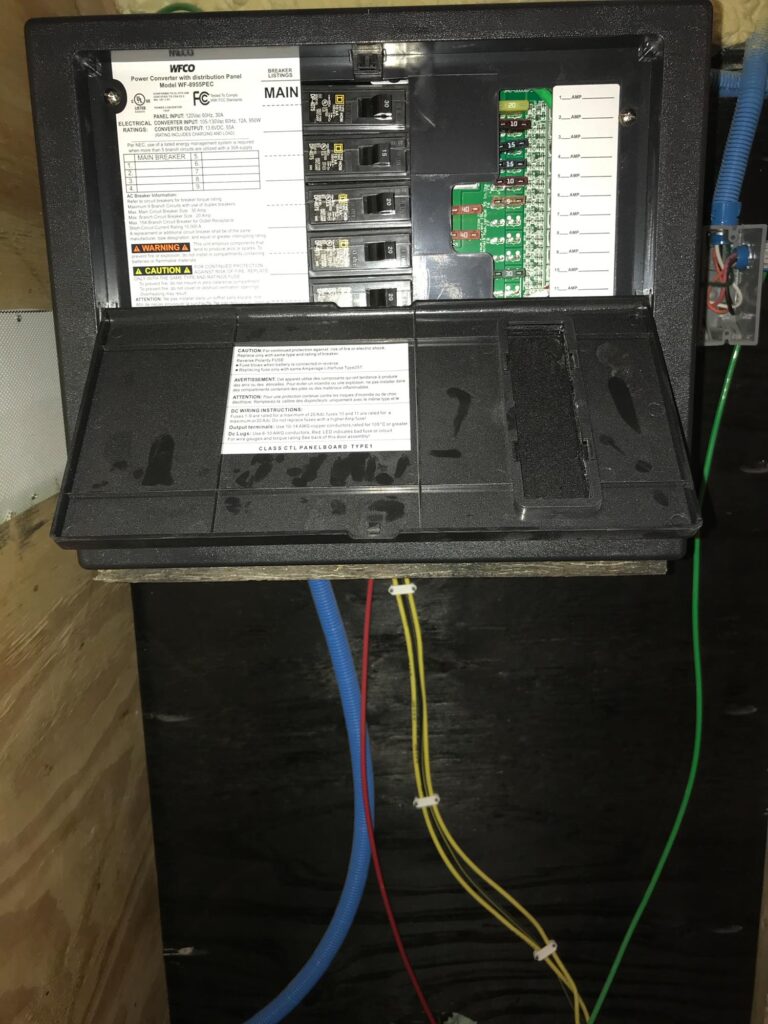
We ran conduit and stranded wire. Installed the power center.
“Finish” Carpentry
We took a brief respite the 3rd week in April for a canoe trip. Since our truck was in the shop I installed a temporary passenger seat with seat belts and we used the bus as a put-in vehicle!
We came back at the end of April and framed the bed, the couch and “nook.”
In May I started building cabinets and drawers. Since we had to address the rust issue, we used NH Oil to undercoat the entire bus.
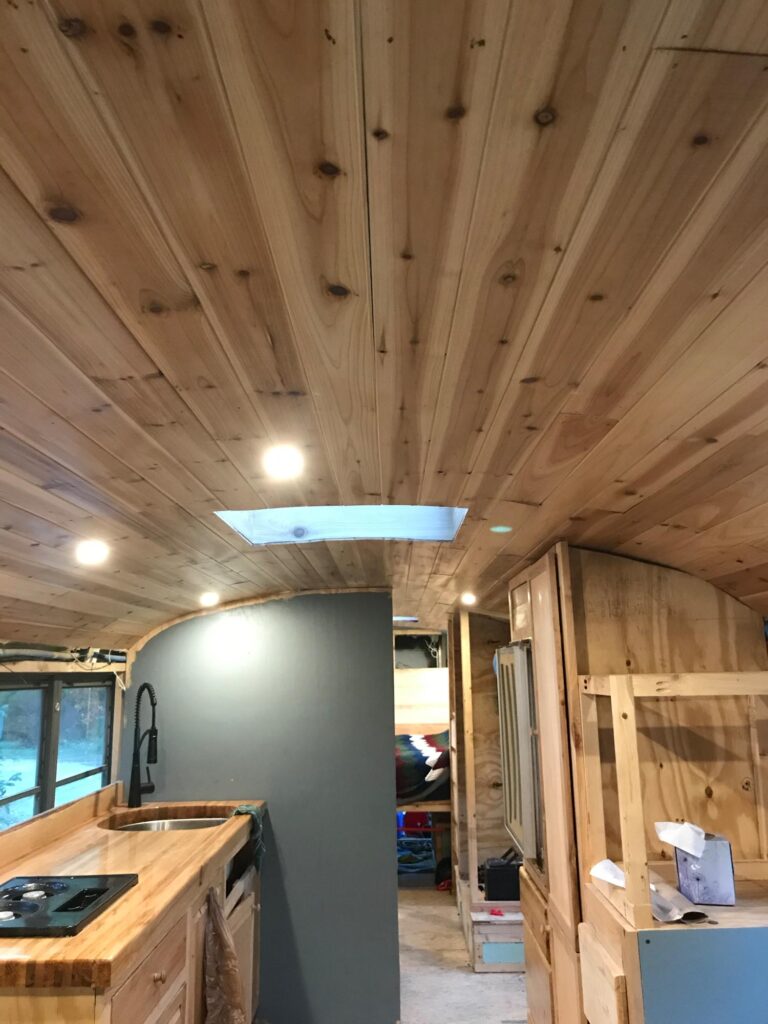
We built custom cedar skylights to replace the old plastic leaky ones. The new ones leaked. I said bad words. Then I figured out the problem and fixed them.
I love the look of natural wood, so we installed some 5/16″ tongue and groove for the ceiling and these LED lights that are great! I found them easy to install, bright enough to illuminate the bus and draw very little power.
Skoolie Conversion Plumbing
I had originally salvaged some blue barrels that I planned to use both as fresh water and grey water tanks. However, I found a free 35 gallon fresh tank, so I installed it under the bed.
Then I used pex tubing to run supply lines to a 12 Volt pump and pressure tank, then to an on-demand hot water heater, to the shower, and to the kitchen sink.
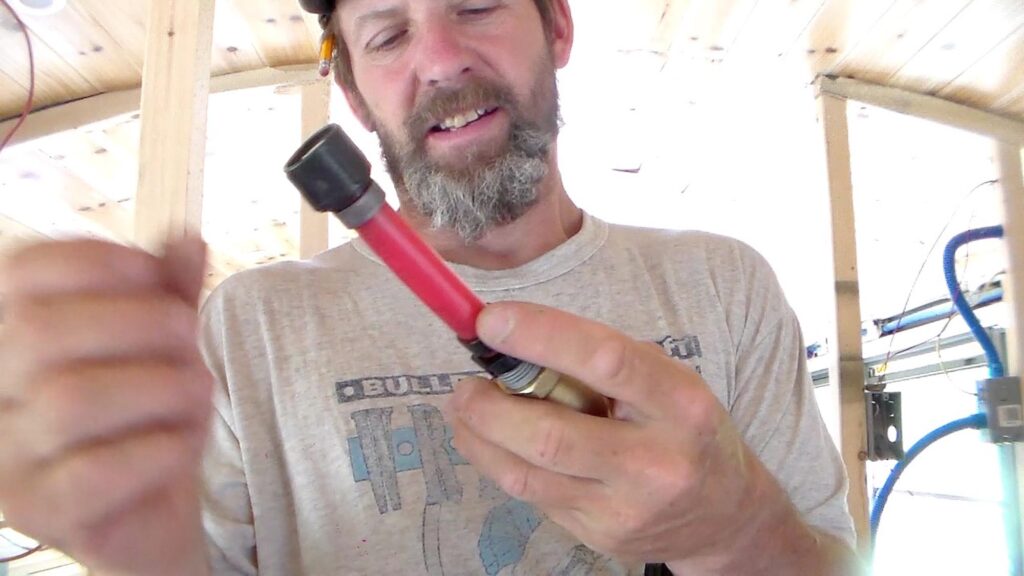
I used the blue barrel as a gray water tank that I hung with threaded rod under the bus.
Bus Life Weekend for Memorial Day
Traditionally we spend Memorial Day weekend on the river. So we decided it would be a great opportunity to test out the bus as a bivouac vehicle and headed to the Forks. We paddled three rivers in three days and learned on some BUMPY back roads that we did, indeed, need to find ways to anchor things down because they went FLYING! I finally figured out the system to use these drawer and cabinet baby locks!
Memorial Day Monday I awoke and checked Craig’s List. Right on the way home someone was giving away a pile of rough-sawn lumber that had been in their father’s shop for years. Perfect!
We picked it up on the way home. This material would later on become our kitchen countertop and cabinets.
With the onset of June, (and more daylight) we put in even more hours. Which is good because everything takes longer than you think.

I milled up a big chunk of the lumber and built a butcher block epoxy poured countertop. I installed the fridge, the stove and ran the propane lines.
Our daughter decided that she was able and wanted to complete a few weekends of raft guide training, so we loaded up the bus and headed north to the river for some whitewater and further bus experimenting.
It was hot and buggy, so when we returned I immediately went to work on building screens.
Then we hit July. Because of Covid, I wasn’t sure if people were going to sign up for whitewater rafting. Since my summer spot doesn’t have the power supply to support table saws and chop saws, I figured I’d stay home for a couple more weeks to work on the bus. However, the phone kept ringing asking me to work, so I loaded up the bus and headed to the Penobscot for the summer.
Mechanical Work
20 minutes from the campground I hit a pothole that sheared both rear shock mounts. The 20 minute ride became an hour ride as I limped down the Golden Road. I finally arrived at my campground spot. Fortunately, I didn’t have to move the bus much for a couple of weeks. I guided rafts during the day and wrestled with rusty bolts at night. I ended up replacing the shocks, shock mounts and the leveling valve.
Skoolie Living!
And that was just about all the bus work that did for the rest of the summer. I took a break and LIVED in it. And it was glorious!
Most mornings I woke at dawn, paddled the Cribworks rapid at sunrise, boated right to the bus, made a cup of tea and walked back upriver to get my truck.
I guided rafts or drove the rafting bus during the day, then kayaked and/or cooked dinner with my rafting buddies at night. Julie still held down a real job (bummer for her) but she managed to get some time off and come live on the bus with me.
And while I enjoyed my summers living in a tent, skoolie life was a major upgrade! A fridge! Lights! A table! (albeit a small one!) Luxury!
Alas, summer had to end, so I returned to my wooden house (shocks intact this time).
I had to return to teaching which severely cut into my bus building time but marginally improved the bank account.
Skoolie Paint
I felt a bit at a loss trying to figure out what to do next but figured that I might as well paint it. Maine law requires skoolies to be anything but National School Bus Yellow. While law enforcement folks had not hassled us about it, I figured I should check that project of the list. So, with clear skies forecast for the weekend we set out to mask, prime and paint the bus. OF course, despite the forecast we had to dodge a couple of showers, but managed to transition from yellow to International Harvester White. (Which is more of a cream color.) Accents to come soon!
With winter coming and more of a hospitable setting inside the bus than last winter, I decided I should shore up defenses against mice. The stock pneumatic door left a good inch gap at the bottom…not good for rodent defense.
A friend of mine had given us some RV windows and I still had some wood left over in the lumber pile, so I mortised and tenoned a door. This door sits on my woodshop table as I write awaiting a door knob and a door stop for the jam. I’m really hoping that I’ll get it on tonight. And install the door.
Conclusion
Whew”¦.
So that’s the year.
We went from “Maybe someday we’ll have a skoolie” to “Hey, we lived in a skoolie all summer.”
We still have a long way to go. But I’d like to think that most of the real difficult tasks are done.
And, if nothing else, having found solutions to past problems gives us the confidence that we will continue to make it work. That mindset goes a long way toward completing the project!
Thanks for joining us on this journey. Feel free to reach out and ask questions at any time!
Ted & Julie